Recent Posts

How To Effectively Clean Your Machine Parts With Vapor Degreasing

Precision parts manufacturing demands effective materials selection, minute attention to design details, precise tools and machines, and highly skilled labor. But even a microscopic speck or smudge of grease, oil or dirt on a part can render all of the above useless. For precision parts to fit together to the correct tolerances and for welds to hold, parts must be impeccably cleaned and free of all traces of contamination. Yet, operational efficiency also must be considered. The ideal cleaning system for parts will be both effective and economical.

Read More »

THE BEST SOLVENTS

FOR ANY APPLICATION

The Complete Guide to Vapor Degreasing: Choosing the Right Solvent and Partner

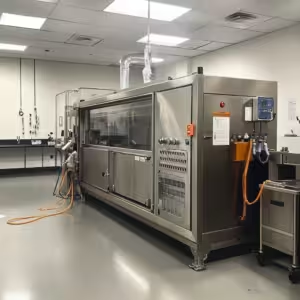
baltoro1_a_vapor_degreaser_machine_in_a_clean_facility_6fc5c9a9-538f-4264-97ce-2098f0e8ba3d

Introduction

Vapor degreasing has been the backbone of precision cleaning in manufacturing for more than 70 years. It is fast, thorough, and capable of reaching contamination in geometries that no other cleaning method can access reliably. Yet for all its advantages, it is also one of the most frequently misunderstood and poorly specified processes in the plant.

Vapor degreasing is one of the most effective and straightforward cleaning processes in manufacturing — yet it remains widely misunderstood. When you pair the right solvent with a knowledgeable technical partner, optimizing the process is more achievable than most operators expect, with meaningful gains in cleanliness, throughput, and total cost of ownership.

This guide covers everything a process engineer, quality manager, or manufacturing director needs to make the right vapor degreasing decisions — from solvent selection fundamentals to EPA compliance to switching solvents in an existing system.

1 – What Is Vapor Degreasing and Why It Outperforms Aqueous Cleaning

How Vapor Degreasing Works

A vapor degreaser is a closed-loop system built around the controlled boiling and condensation of a solvent. The process works like this:

  1. Solvent in the sump is heated to its boiling point, generating a dense vapor zone in the upper portion of the machine.
  2. The part to be cleaned is lowered into the vapor zone. The cool metal surface causes the solvent vapor to condense on the part.
  3. The condensing solvent dissolves and flushes contamination — oils, greases, waxes, flux residues, particulates — off the part surface and drains back into the sump.
  4. The part may or may not enter the boiling liquid or a sump with an ultrasonic wand.  This mechanical action can help remove non-soluble debris before the part is moved back into the freeboard zone to dry.
  5. The part is removed clean and dry — the condensed solvent drains back into the liquid sump, re-enters the vapor zone, and evaporates completely as the part returns to ambient temperature, leaving no residue behind.
  6. Freeboard chillers and carbon adsorbers capture solvent emissions, keeping losses minimal and the operating environment safe.

The result is a clean, dry, residue-free part.

Why Vapor Degreasing Outperforms Aqueous Cleaning

Aqueous cleaning systems — water-based washers using surfactants, alkaline cleaners, or detergents — are a common alternative to vapor degreasing. They work well for many applications. But in precision manufacturing, the differences matter significantly.

Geometry access.  Vapor degreasing reaches blind holes, tight tolerances, under-component gaps on PCBs, and complex internal channels that aqueous systems cannot reliably penetrate. Surface tension in water is approximately 72 mN/m. Quality vapor degreasing solvents carry surface tension values below 20 mN/m — meaning the solvent wets and penetrates surfaces that water-based systems physically cannot reach.

Cycle time.  A typical vapor degreasing cycle runs 1–5 minutes per load. Aqueous systems, particularly those requiring hot rinse and dry stages, routinely run 15–45 minutes per cycle and require separate drying equipment.

Residue.  Vapor degreasing solvents evaporate completely and leave zero residue. Aqueous systems often leave behind water spots, mineral deposits, and surfactant residue — particularly problematic in electronics, medical device, and aerospace applications where cleanliness specifications are tight.

Energy cost.  Counter-intuitively, vapor degreasing often has a lower energy footprint per part cleaned than aqueous systems, which require sustained heating of large water volumes across wash, rinse, and dry stages.

Waste cost. Aqueous systems generate significant volumes of contaminated wastewater that must be treated and disposed of as regulated waste. Modern vapor degreasing solvents like NEXT HD Pro are non-hazardous and consumed in far lower volumes — reducing waste disposal costs and simplifying compliance.

Floor space.  A vapor degreaser occupies a fraction of the floor space of an equivalent-capacity inline aqueous washer — a real operational advantage where facility space is at a premium.

Where aqueous has the edge:  High-volume, low-complexity parts with simple contamination profiles and no tight geometry requirements. Aqueous is also preferred where solvent regulatory pressure in a specific jurisdiction makes vapor degreasing politically or operationally difficult.

2 – How to Evaluate Vapor Degreasing Solvents

Solvent selection is the single most consequential decision in vapor degreasing system design and operation. The wrong solvent produces marginal cleaning results, damages parts, creates worker safety and compliance exposure, or drives operating costs above the level at which vapor degreasing remains economically justified.

Kauri-Butanol (KB) Value — Solvency Strength

The KB value is the standard measure of a solvent’s solvency strength — specifically, its ability to dissolve hydrocarbon-based contamination. Higher numbers indicate stronger solvency.

  • KB value < 30: Weak solvency — suitable for light contamination and post-rinse applications
  • KB value 30–60: Moderate solvency — appropriate for light oils, thin films, light flux residues
  • KB value 60–100: Strong solvency — suitable for heavy greases, waxes, heavy flux, machining oils
  • KB value > 100: Very aggressive solvency — effective on heavy soils but requires careful substrate compatibility evaluation

The critical error many operators make is specifying a solvent with solvency lower than the contamination profile actually requires, then compensating with longer cycle times — which increases cost without reliably improving cleanliness. Match the KB value to the contamination, not to what seems safe or conservative.

Boiling Point — Process Window and Safety
  • Lower boiling point solvents (below ~50°C): More aggressive in vapor generation; can be more difficult to control in the freeboard zone. Higher vapor pressure increases emission rates if the machine is not properly sealed and cooled.
  • Mid-range boiling point solvents (50–120°C): The sweet spot for most vapor degreasing applications — sufficient vapor generation, manageable vapor pressure for emission control, and compatibility with most metal, plastic, and elastomer substrates.
  • Higher boiling point solvents (above 120°C): Slower to evaporate; may leave residue on parts if the cycle is not long enough to achieve complete dry-out.
  • Energy Consumption: Boiling point also affects energy consumption — higher boiling point solvents require more energy to sustain the vapor zone and longer cycle times for parts to reach dry-out temperature. That said, boiling point isn’t simply a variable to minimize. Some contaminants, such as paraffins, require the elevated temperatures of a higher boiling point solvent to be effectively removed, making it a process-driven selection criterion, not just an efficiency one.
Flash Point — Flammability and Safety Classification

For most precision manufacturing environments, non-flammable solvents are strongly preferred. Many of the solvents that displaced older chlorinated and brominated agents in vapor degreasing are non-flammable — this is one of their core operational advantages and should be treated as a baseline requirement. A solvent with a flash point introduces fire risk classification requirements, storage constraints, and potential facility permitting complications that most manufacturers would rather avoid.

Vapor Pressure

Vapor pressure governs how readily the solvent evaporates at operating temperature. Higher vapor pressure means more aggressive vapor generation — beneficial for cleaning performance, but it can increase vapor losses and requires more robust freeboard chiller capacity to maintain emission compliance.

Substrate Compatibility

Before specifying or switching a solvent, verify compatibility with every substrate in the parts you clean — including base metals, platings, coatings, elastomers, plastics, adhesives, and any other materials the solvent will contact. Solvent incompatibility can cause swelling, cracking, discoloration, or extraction of plasticizers and coatings. Enviro Tech International provides substrate compatibility testing as part of its solvent evaluation process.

3 – Cost Comparison: Vapor Degreasing vs. Aqueous vs. Manual Cleaning

Capital Cost

Vapor degreasing equipment ranges from small benchtop units for lab or prototype cleaning (under $10,000) to large production degreasers for aerospace or automotive applications ($50,000–$250,000+). Aqueous inline washers occupy a similar capital range. Manual cleaning with buckets, brushes, and wipes has near-zero capital cost but significant and often uncounted labor and compliance cost.

Operating Cost Drivers

Cost Category

Vapor Degreasing

Aqueous Cleaning

Manual Cleaning

Labor per part

Very low

Low–Medium

High

Cycle time

1–5 min

15–45 min

Variable

Energy

Medium

Medium–High

Low

Solvent/chemistry consumption

Low (closed loop)

Medium (drag-out, rinse)

High (open use)

Wastewater treatment

None

Required

Potential

Floor space

Low

Medium–High

Low

Rework rate

Very low

Low–Medium

High

Compliance cost

Moderate (solvent tracking)

Low–Moderate

Moderate–High


The Hidden Cost: Rework and Rejection

In precision manufacturing, the most significant cost difference between cleaning methods often shows up downstream — in rework rates, field failures, and rejected lots. An aqueous system that leaves surfactant residue on a PCB assembly or mineral deposits on a medical device component can generate scrap and rework costs that dwarf any operating cost advantage. Vapor degreasing, when properly specified and operated, delivers a consistently clean, dry, residue-free part that aqueous systems cannot match in demanding applications.

Wastewater: The Aqueous Hidden Cost

Every aqueous cleaning system generates contaminated process water that typically requires treatment before discharge. Treatment costs commonly add $0.10–$0.50 per gallon processed. A mid-size aqueous system processing several hundred gallons per day can generate $10,000–$50,000 or more in annual wastewater treatment costs. Vapor degreasing generates no process wastewater.

4 – Industry-Specific Requirements

Aerospace

Aerospace cleaning requirements are among the most demanding in manufacturing. Specification compliance — MIL-PRF-680, AMS 2651, and customer-specific specs — typically requires documented solvent qualification and process validation. Parts routinely include aluminum alloys, titanium, high-strength steel, composite materials, and specialized coatings, each with different compatibility requirements. Enviro Tech’s NEXT HD Pro and EnSolv product lines are formulated to meet the compatibility and documentation requirements of aerospace quality systems.

Medical Devices

Medical device cleaning is governed by FDA quality system regulations (21 CFR Part 820) and ISO 13485, both of which require validated cleaning processes with documented evidence of effectiveness. Key considerations include bioburden and endotoxin control, material compatibility across a wide range of polymers and adhesives, extractables and leachables characterization for implantable or patient-contacting devices, and full validation documentation. Enviro Tech provides technical documentation to support medical device cleaning validation.

Electronics and PCB Assembly

Electronics cleaning — particularly defluxing after solder assembly — is one of the highest-volume precision cleaning applications for vapor degreasing. In high-reliability applications (military, aerospace, automotive safety, medical), it is not optional. The KB value and polarity of the cleaning solvent must be matched to the specific flux chemistry used. The move to fine-pitch, high-density PCB assemblies makes under-component cleaning increasingly dependent on vapor degreasing’s low surface tension advantage. Cleanliness requirements are governed by IPC-7711/7721, IPC-CH-65, and IPC J-STD-001.

5 – Environmental Compliance: EPA-Compliant Solvents for Vapor Degreasing

Solvent regulation is the most rapidly changing aspect of vapor degreasing operations. The EPA has been systematically reviewing and restricting solvents under TSCA Section 6, and the pace of new rules has accelerated significantly since 2020.

The PERC Phase-Out

The EPA’s 2024 TSCA Section 6 final rule established an ECEL of 0.14 ppm for perchloroethylene (PERC) — 700 times lower than OSHA’s existing PEL.  While the deadline for its enforcement was delayed from March 2026 to a later date, it is still imminent.

nPB Regulatory Status

n-Propyl bromide (nPB), used in Enviro Tech’s EnSolv product line, is subject to ongoing EPA scrutiny. Facilities using nPB should monitor regulatory developments and discuss long-term exposure management with Enviro Tech’s technical team.

TCE Status

Trichloroethylene (TCE) is effectively banned for virtually all industrial applications under the EPA’s 2024 TSCA rule, with near-complete phase-out timelines. Any facility still using TCE in vapor degreasing must treat this as an urgent compliance matter.

What Compliant Alternatives Look Like

Enviro Tech’s NEXT HD Pro — a trans-1,2-dichloroethylene and fluorinated carrier blend — carries no TSCA Section 6 restrictions, no ODP, and is non-flammable. It is formulated with current and anticipated regulatory requirements as a core design parameter.

6 – Changing Solvents in Existing Vapor Degreasing Equipment: Step-by-Step

Switching solvents in an existing vapor degreaser requires careful planning but is well within the capability of any facility with competent engineering support. Rushing it, or skipping steps, is where problems arise.

  1. Confirm Equipment Compatibility. Verify that your vapor degreaser is compatible with the new solvent’s boiling point, vapor pressure, and freeboard chiller capacity. Confirm gasket, seal, and material compatibility. Enviro Tech will confirm compatibility with your specific equipment model before you commit to a purchase.
  2. Drain and Remove Existing Solvent. Drain the sump completely. Do not blend old and new solvents. For chlorinated or brominated solvents, dispose of the spent solvent as hazardous waste per RCRA requirements through a licensed contractor.
  3. Clean the Machine Interior. Wipe down the sump interior, heating coils, cooling coils, and freeboard surfaces. For machines running heavily contaminated solvents, a full machine cleaning with a small sacrificial charge of the new solvent is recommended before loading the production charge.
  4. Inspect and Replace Seals and Gaskets if Needed. If switching from a chlorinated solvent to a trans-DCE blend, inspect all door seals, hose connections, and gaskets. Replace any components that show swelling, brittleness, or chemical attack.
  5. Charge the New Solvent. Add the new solvent charge per the manufacturer’s recommended fill level. Do not overfill — the solvent level in the sump determines the vapor zone height and affects both cleaning performance and emission control.
  6. Run Qualification Parts. Before returning to production cleaning, run qualification parts representing the range of geometries and contamination profiles in your production mix. Verify cleanliness to your specification and document the results. In regulated industries, this is the beginning of your process change documentation.
  7. Update Hazard Communication and SDS. Every SDS, hazard communication label, and worker training record must be updated to reflect the new solvent before production cleaning begins. This is an OSHA HazCom requirement.
  8. Establish New Operating Parameters. Monitor solvent bath concentration, boiling point stability, and freeboard temperature over the first several production days. Confirm that azeotropic or near-azeotropic behavior of blended solvents is stable and that cleaning performance is consistent across your part range.

Enviro Tech provides technical support throughout this process, including assistance with qualification testing, documentation, and ongoing solvent analysis.

7 – Why Enviro Tech International: Technical Depth, Regulatory Knowledge, and the Right Product for Your Process

Enviro Tech International is a specialty solvent manufacturer with decades of experience supplying precision cleaning solvents to manufacturers in aerospace, electronics, medical device, automotive, and defense industries. We’re not a distributor sourcing from commodity suppliers. We formulate, manufacture, and technically support the products we sell.

NEXT HD Pro: High-Performance Vapor Degreasing Without Regulatory Risk

NEXT HD Pro is Enviro Tech’s flagship vapor degreasing solvent, a high-performance blend of trans-1,2-dichloroethylene and a fluorinated carrier designed for demanding precision cleaning applications. It is the primary recommendation for manufacturers transitioning away from PERC, TCE, or nPB.

  • Non-flammable
  • Zero ODP
  • No TSCA Section 6 restrictions
  • Fast drying, zero residue
  • Low surface tension for penetration into tight geometries
  • Compatible with most metals, plastics, and elastomers
  • Available in multiple formulations (HD Pro, HD Pro 43, HD Pro 43A, HD Pro 70, HD Pro 70A) to match specific boiling point and concentration requirements

EnSolv: nPB-Based Performance for Heavy Contamination Profiles

EnSolv is Enviro Tech’s n-propyl bromide based precision cleaning solvent, offering strong solvency (KB value suited for heavy greases, waxes, and oils) with a boiling point of 70°C, vapor pressure of 134 mmHg, and specific gravity of 1.31. It is used in aerospace, automotive, and electronics applications where contamination profiles require stronger solvency than trans-DCE blends provide.

EnSolv users should discuss regulatory trajectory and workplace exposure management with Enviro Tech’s technical team, given ongoing EPA and OSHA scrutiny of nPB.

Technical Support That Goes Beyond the Sale

Choosing Enviro Tech means access to a technical team that understands both the chemistry and the cleaning application. We offer:

  • Application-specific solvent recommendation based on contamination type, substrate, equipment, and regulatory environment
  • Substrate compatibility testing for new solvent evaluations
  • Regulatory compliance documentation — SDS, TDS, SNAP listing confirmation, and customer quality system documentation support
  • Ongoing solvent analysis — send us a sample of your bath solvent and we’ll tell you what’s in it and whether it’s time to change

We know the industrial cleaning solvent market deeply, and we know the regulatory landscape as well as anyone. When EPA rules change, and they do, we help our customers stay ahead of it, not scramble to react.

Frequently Asked Questions

What is vapor degreasing used for?

Vapor degreasing is used for precision cleaning of metal and other manufactured parts — removing oils, greases, waxes, flux residues, and other contamination prior to coating, bonding, assembly, inspection, or shipment. It is used across aerospace, electronics, medical device, automotive, and defense manufacturing.

Is vapor degreasing better than aqueous cleaning?

For precision parts with complex geometry, tight cleanliness specifications, or fast cycle time requirements, vapor degreasing typically outperforms aqueous cleaning. Its ultra-low surface tension solvents penetrate geometries that water-based systems cannot reach, it produces zero residue, and it is faster per cycle. Aqueous cleaning is preferred for high-volume, simple-geometry applications or where solvent use is restricted.

What solvents are used in vapor degreasing?

Modern vapor degreasing solvents include trans-1,2-dichloroethylene blends (such as Enviro Tech’s NEXT HD Pro), n-propyl bromide (nPB) based solvents (such as Enviro Tech’s EnSolv), and hydrofluorocarbon and hydrofluoroether blends. PERC (perchloroethylene) and TCE (trichloroethylene) are being phased out under EPA TSCA Section 6 regulations.

What is KB value in solvent cleaning?

KB value (Kauri-Butanol value) measures a solvent’s solvency strength — its ability to dissolve hydrocarbon-based contamination. Higher KB values indicate stronger solvency. Matching KB value to the contamination profile is critical for effective vapor degreasing.

How do I switch solvents in my vapor degreaser?

Switching solvents requires draining the existing charge, cleaning the machine interior, confirming equipment compatibility with the new solvent, charging the new solvent, running qualification parts, and updating hazard communication documentation. Enviro Tech provides technical support for the full changeover process.

What replaced PERC in vapor degreasing?

Trans-1,2-dichloroethylene blends such as Enviro Tech’s NEXT HD Pro are the most widely adopted PERC replacement for vapor degreasing. They are non-flammable, carry no TSCA Section 6 restrictions, and provide comparable cleaning performance for most industrial contamination profiles.